
Optics reference
One section per family — the shape, carrier, primary use case, and a minimal runnable example. For the per-method reference see the Scaladoc.
Everything here is the construction side of the library's core
doctrine — consume via capability, construct via optic. The
concrete families below (Lens, Prism, Getter, …) are what you
build and compose; when a signature consumes an optic — an API
seam, a using parameter — take the weakest
capability trait (CanGet, CanModify,
CanFold, …) instead of a concrete type. And if a signature must
take a raw Optic[…, F] together with a typeclass gate on F,
read the
using-clause ordering footgun
before writing it.
Family taxonomy
Every family is a specialisation of the same Optic[S, T, A, B, F]
trait, differing only in the carrier F[_, _] — and the family space
is three-axis:
- focus nature — how
tolands the focus: total (always there), fallible (may miss), or multiple (anF-layer of foci). This is exactly the latticeReadComposejoins along. - source nature — what
fromneeds to rebuild the source: total (no context — a bijection or amend), contextual (carries the leftoverX), or fallible (the rebuild itself can reject). The fallible row — and aWriteComposejoin mirroringReadCompose— is not shipped yet: it is the territory of the failure-typed-build (BiAffine) plan. - capability — which sides exist at all: read-only (top layer), read-write (middle), write/build-only (bottom).
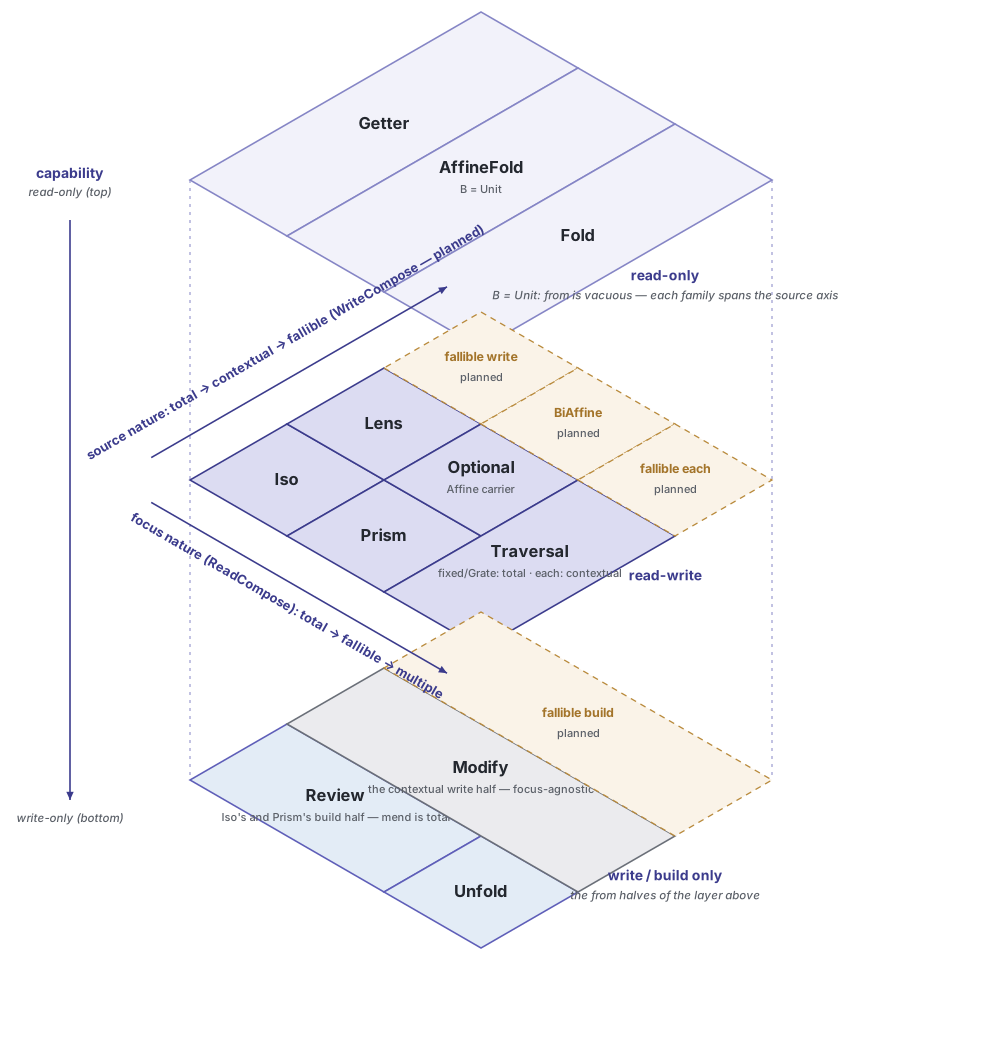
How to read it:
- The top layer is read-only: Getter (total), AffineFold
(fallible), Fold (multiple), each drawn as a bar spanning the
whole source axis. That span is honest, not decorative: read-only
optics pin their write side to
Unit— the terminal type, not the bottom typeNothing— and a function intoUnitexists uniformly for every input, so the vestigialfromis vacuously satisfied at every source nature. (HadBbeenNothing, nofromcould exist at all.) It is the exact dual ofModifyspanning the focus axis below. Any chain that touches a read-only optic projects up onto this layer, landing at the join of the focus natures —lens ∘ getter→ Getter,prism ∘ getter→ AffineFold,traversal ∘ getter→ Fold. That join is exactly whatReadComposecomputes. - The middle layer is the full grid, and with these axes it is
completely inhabited — every cell is shipped or planned, no
accidental holes. Iso is total in both focus and source; Lens reads
totally but rebuilds contextually; Prism reads fallibly but mends
totally; Optional is fallible-focus, contextual-source (the
Affinecarrier). At multiple focus, context-freeIndexed.Graterebuilds totally via tabulation, while container Traversal (MultiFocus[PSVec], includingtwo/three/four) rebuilds contextually, keeping its structural skeleton. GeneralIndexedcan also retain nontrivial residualX. - The bottom layer is write/build-only — but unlike the top
layer it is a full plane, not a rail: a write-only optic's
fromis real (only itstois vestigial), so both axes still apply, and each family sits directly below the read-write cells whose build half it is. Review spans the cells below both Iso and Prism — amendis total, so the two share one build half; Unfold below Traversal's total flank (multiple focus:embed: F[B] => T, Fold's mirror on the sameForget[F]carrier);Modifyis the whole contextual row — it is the contextual write half of Lens / Optional /each, never observing the focus shape it lands on; fallible build is the planned fallible row. Build-side composition projects down onto this layer (iso ∘ review→ Review,review ∘ unfold→ Unfold,lens ∘ modify→ Modify). - The tan cells are planned, not missing by accident — they are
the fallible-source row: fallible write (a smart-constructor
replace that can reject), BiAffine (fallible in both focus and
source), and fallible each (per-element write failures, the shape
the Avro integration already runs on read). Together with the
WriteComposejoin they are scoped to the failure-typed-build spike (docs/brainstorms/2026-06-10-failure-typed-build-biaffine.md).
Affine is the carrier shared by Optional (read and write) and
AffineFold (read-only). MultiFocus[F] is the container multi-focus
carrier; fixed-index Indexed uses GlassF[I] instead.
Forget[F] is the one-way many carrier shared by
Fold (read-only) and Unfold (build-only).
Composition matrix
The full 11-family grid. Every cell is pinned by
CompositionMatrixSpec:
an inhabited cell composes via plain .andThen with no expected-type
ascription and no given imports, landing at the family shown; ∅
cells do not compile, by design (writing through a read-only optic,
reading through a build-only one, building through a write-incapable
one). 87 of 121 cells compose; 34 are void.
| outer ∘ inner | Iso | Lens | Prism | Optional | Traversal | Getter | AffineFold | Fold | Modify | Review | Unfold |
|---|---|---|---|---|---|---|---|---|---|---|---|
| Iso | Iso | Lens | Prism | Optional | Traversal | Getter | AffineFold | Fold | Modify | Review | Unfold |
| Lens | Lens | Lens | Optional | Optional | Traversal | Getter | AffineFold | Fold | Modify | ∅ | ∅ |
| Prism | Prism | Optional | Prism | Optional | Traversal | AffineFold | AffineFold | Fold | Modify | Review | Unfold |
| Optional | Optional | Optional | Optional | Optional | Traversal | AffineFold | AffineFold | Fold | Modify | ∅ | ∅ |
| Traversal | Traversal | Traversal | Traversal | Traversal | Traversal | Fold | Fold | Fold | Modify | ∅ | ∅ |
| Getter | Getter | Getter | AffineFold | AffineFold | Fold | Getter | AffineFold | Fold | ∅ | ∅ | ∅ |
| AffineFold | AffineFold | AffineFold | AffineFold | AffineFold | Fold | AffineFold | AffineFold | Fold | ∅ | ∅ | ∅ |
| Fold | Fold | Fold | Fold | Fold | Fold | Fold | Fold | Fold | ∅ | ∅ | ∅ |
| Modify | Modify | Modify | Modify | Modify | Modify | ∅ | ∅ | ∅ | Modify | ∅ | ∅ |
| Review | Review | ∅ | Review | ∅ | ∅ | ∅ | ∅ | ∅ | ∅ | Review | Unfold |
| Unfold | Unfold | ∅ | Unfold | ∅ | ∅ | ∅ | ∅ | ∅ | ∅ | Unfold | Unfold |
The structure of the voids is the taxonomy speaking:
- The Modify column/row corner: a Modify exposes no focus to read and no value to build with, so only write-capable pairs survive.
- The Review / Unfold columns are void for every outer that cannot
build totally (Lens, Optional, Traversal — their write-back needs a
leftover the build-only inner never produces; Getter / AffineFold /
Fold — their back-focus is honestly
Unit, so there is nothing to build with). Only the reversible outers (Iso, Prism, Review, Unfold) reach them. - The Review / Unfold rows mirror the columns: a build-only outer
exposes no readable focus, so only build halves (Iso / Prism via
ReverseAccessor, Review, Unfold) compose in.
Four mechanisms produce the inhabited cells, all resolved at compile
time: same-carrier AssociativeFunctor, cross-carrier
Morph/Composer bridges, the ReadCompose read-collapse (any pair
with a read-only side), and the ReverseAccessor-gated build-collapse
(the Review / Unfold cells). See
Concepts → Composition lattice for
the carrier-level bridge graph.
The grid is carrier-level: Traversal is MultiFocus[PSVec]
(each, Plated). Indexed uses GlassF[I] and dedicated
product-index composition; its classical-family bridges are not
installed. See QA → The Indexed footprint.
A ✓ asserts that a chain type-checks without import or ascription,
not a universal proof of its runtime laws. Behaviour tests provide
separate evidence.
import dev.constructive.eo.optics.{Lens, Optic}
import dev.constructive.eo.optics.Optic.*
// `Fold.apply` / `.select` now return the concrete `ForgetFold`, whose eager `foldMap`
// member needs no `import Forget.given` — the carrier's `ForgetfulFold` is no longer summoned.
// (Accessor[Direct] etc. resolve via `object Direct`'s companion scope — `Direct` is an
//  opaque type, so no `import Direct.given` is needed for `.get` on Iso / Getter.)
Every page here shows optics constructed by hand. For the
macro-derived lens[S](_.field) / prism[S, A] flavour, see
Generics.
Iso
An Iso[S, A] is a bijection — every S round-trips to exactly
one A and back. Carrier: Direct (the identity carrier).
import dev.constructive.eo.optics.Iso

case class PersonPair(age: Int, name: String)
val pairIso = Iso[(Int, String), (Int, String), PersonPair, PersonPair](
  t => PersonPair(t._1, t._2),
  p => (p.age, p.name),
)pairIso.get((30, "Alice"))
// res0: PersonPair = PersonPair(age = 30, name = "Alice")
pairIso.reverseGet(PersonPair(30, "Alice"))
// res1: Tuple2[Int, String] = (30, "Alice")Lens
A Lens[S, A] focuses a single, always-present field of a
product type. Carrier: Tuple2.
case class Person(name: String, age: Int)
val ageL = Lens[Person, Int](_.age, (p, a) => p.copy(age = a))
val alice = Person("Alice", 30)
// alice: Person = Person(name = "Alice", age = 30)
ageL.get(alice)
// res2: Int = 30
ageL.replace(31)(alice)
// res3: Person = Person(name = "Alice", age = 31)
ageL.modify(_ + 1)(alice)
// res4: Person = Person(name = "Alice", age = 31)Composes via .andThen with other Lenses and — transparently,
with no extra syntax — with Optional / Modify / Traversal
optics too. The cross-carrier variant of .andThen summons a
Composer[F, G] or Composer[G, F] to bring both sides under
a common carrier.
Prism
A Prism[S, A] focuses one branch of a sum type — Some over
None, or a specific case of an enum. Carrier: Either.
import dev.constructive.eo.optics.Prism

enum Shape:
  case Circle(r: Double)
  case Square(s: Double)

val circleP = Prism[Shape, Shape.Circle](
  {
    case c: Shape.Circle => Right(c)
    case other           => Left(other)
  },
  identity,
)circleP.to(Shape.Circle(1.0))
// res5: Either[Shape, Circle] = Right(Circle(1.0))
circleP.to(Shape.Square(2.0))
// res6: Either[Shape, Circle] = Left(Square(2.0))
// modify acts only on the Circle branch; Squares pass through
// unchanged.
circleP.modify(c => Shape.Circle(c.r * 2))(Shape.Circle(1.0))
// res7: Shape = Circle(2.0)
circleP.modify(c => Shape.Circle(c.r * 2))(Shape.Square(2.0))
// res8: Shape = Square(2.0)For auto-derivation on enums / sealed traits / union types see
prism[S, A] in Generics.
Composed with a traversal in either direction, a prism filters:
traversal.andThen(prism) visits only the elements that match, and
prism.andThen(traversal) walks the inner structure only when the
outer branch matches. Both return a concrete Traversal, so they stay
nameable and on the fused path. The load-bearing law is that a miss is
rebuilt untouched — never dropped, so length and order survive:
import dev.constructive.eo.optics.Traversalval circles = Traversal.each[List, Shape].andThen(circleP)
// circles: Traversal[List[Shape], List[Shape], Circle, Circle] = dev.constructive.eo.optics.ComposedTraversal@220dfc66
val mixed = List(Shape.Circle(1.0), Shape.Square(2.0), Shape.Circle(3.0))
// mixed: List[Shape] = List(Circle(1.0), Square(2.0), Circle(3.0))
circles.foldMap(_ => 1)(mixed) // two of the three elements match
// res9: Int = 2
circles.modify(c => Shape.Circle(c.r * 10))(mixed) // the Square is still there
// res10: List[Shape] = List(Circle(10.0), Square(2.0), Circle(30.0))Affine
The Affine carrier focuses a value that may or may not be present —
a 0-or-1 focus. Two families ride it: Optional (read and write)
and AffineFold (read-only).
A miss is not an error. Across the core carriers the miss branch
is silent pass-through: .modify / .replace return the source
unchanged, .getOption returns None — no failure value is
allocated or surfaced, because core has no failure channel (that is
the planned fallible tier — BiAffine — in the
taxonomy above). When a miss must be
observable, that lives at the integration boundaries: the
circe optics surface misses and decode
failures as Ior[Chain[JsonFailure], Json], and the
Avro optic's .record face returns
Ior[Chain[AvroFailure], IndexedRecord] — while the raw byte
surfaces (the Avro default and jsoniter) stay deliberately silent
for the hot path.
Optional
An Optional[S, A] focuses a conditionally-present field — an
Option[A] field, a predicate-gated access, a refinement-style
narrowing.
import dev.constructive.eo.optics.Optional

case class Contact(flag: Option[String])

val presentFlag = Optional[Contact, Contact, String, String](
  getOrModify = c => c.flag.toRight(c),
  reverseGet  = { case (c, s) => c.copy(flag = Some(s)) },
)presentFlag.modify(_.toUpperCase)(Contact(Some("hello")))
// res11: Contact = Contact(Some("HELLO"))
presentFlag.modify(_.toUpperCase)(Contact(None))
// res12: Contact = Contact(None)Composition with a Lens is automatic: lens.andThen(optional)
summons Composer[Tuple2, Affine] under the hood and morphs
the Lens into the Affine carrier. No explicit .morph required
on your end.
Read-only / write-only collapse. Composing any optic with a
read-only Getter projects it to its read-only counterpart:
the Getter's Unit back-focus can't thread through a writable
B, so the write side is forgotten (T = B = Unit). The
ReadCompose[F, G] join picks the result from the two read
strengths — total ∘ total yields a Getter, any partial side an
AffineFold, any many-focus side a Fold:
lens.andThen(getter)       // Getter
optional.andThen(getter)   // AffineFold  (partial read)
prism.andThen(getter)      // AffineFold
traversal.andThen(getter)  // Fold        (many reads)
The same join fires with the read-only optic on the outside
(getter.andThen(lens) → Getter, fold.andThen(prism) → Fold), so
a chain that touches a read-only optic anywhere collapses to the
read-only rung at the join of all its read strengths.
Dually, composing with a write-only Modify collapses the read
side and yields a Modify (lens.andThen(modify),
optional.andThen(modify), …) — it modifies the focus through the
inner modifier. One rule per side, across the whole algebra, rather
than a per-family special case.
AffineFold (read-only)
The read-only projection of an Affine — a 0-or-1 focus with no
write-back path. Optional.readOnly / Optional.selectReadOnly
build one from the "read-only Optional" mental model. Full
treatment, with the read-only-direction story, lives in
Single direction → AffineFold.
MultiFocus
MultiFocus[F][X, A] = (X, F[A]) — a structural leftover paired with
an F-shaped container of foci. It backs traversal and aggregation;
the surface lights up by the
typeclasses F admits (.modify for Functor, .foldMap for
Foldable, .modifyA for Traverse,
.collectMap / .collectList for aggregation, and same-carrier
.andThen). The sub-shapes below are just different Fs.
See the MultiFocus reference for the full typeclass-gated capability matrix and composability profile; the Cookbook ships runnable recipes for the Grate, Kaleidoscope, and PowerSeries shapes.
PowerSeries
MultiFocus[PSVec] — the Traversal.each / Traversal.pEach
carrier. Map, fold, or traverse every element of a collection, and
keep composing past the traversal with .andThen. Supports .modify
/ .replace (Functor), .foldMap (Foldable), .modifyA / .all
(Traverse), and downstream .andThen via mfAssocPSVec. Overhead
over a naive copy/map runs ~2-3× for dense chains and ~5× for the
Prism miss-branch shape, amortising down as the collection grows (the
benchmarks
sweep sizes 4 / 32 / 256 / 1024).
Plated — the recursive self-traversal behind transform / universe
/ everywhere — rides this same MultiFocus[PSVec] carrier via
Traversal.selfChildren; it's a typeclass over the carrier, not a new
family node. See Generics → plate[S], the
Cookbook, and the Modify section for
everywhere.
import dev.constructive.eo.optics.Traversal

val listEach = Traversal.pEach[List, Int, Int]listEach.modify(_ + 1)(List(1, 2, 3))
// res13: List[Int] = List(2, 3, 4)
listEach.foldMap(identity[Int])(List(1, 2, 3)) // sum
// res14: Int = 6each shines when the chain continues past the traversal — e.g.
"for every phone, toggle isMobile":
case class Phone(isMobile: Boolean, number: String)
case class Owner(phones: List[Phone])

val ownerAllPhonesMobile =
  Lens[Owner, List[Phone]](_.phones, (o, ps) => o.copy(phones = ps))
    .andThen(Traversal.each[List, Phone])
.andThen(Lens[Phone, Boolean](_.isMobile, (p, m) => p.copy(isMobile = m)))ownerAllPhonesMobile.modify(!_)(Owner(List(
Phone(isMobile = false, "555-0001"),
Phone(isMobile = true, "555-0002"),
)))
// res15: Owner = Owner(
// List(
// Phone(isMobile = true, number = "555-0001"),
// Phone(isMobile = false, number = "555-0002")
// )
// )Kaleidoscope
MultiFocus[F] for an F with Functor — aggregation: collapse
every focus to a single value with .collectMap (Functor-broadcast)
or .collectList (List cartesian). Reach for it when you want to read
the foci out as one summary rather than rewrite them in place. See
MultiFocus reference and
Cookbook → Recipe B.
collectList supplies a singleton focus vector with observed
context, not a guaranteed singleton source. Shape/count-coupled
composites can reject a cardinality mismatch.
AlgLens[F]
MultiFocus[F] for F: Functor / Foldable / Traverse — an algebraic
("classifier") lens whose focus is computed over the structure: the
read side folds/classifies, the write side broadcasts back. The
MultiFocus.fromLensF / fromPrismF / fromOptionalF factories lift
a single-focus optic over an F[A] focus into this shape. See the
MultiFocus reference.
Indexed
The full-grid successor to the legacy Function1-based Grate is an
ordinary Optic with a fixed-index carrier. The trait and companion live
in optics/Indexed.scala; the carrier remains in data/Glass.scala:
type GlassF[I] = [X, A] =>> (context: X, values: I => A)
trait Indexed[S, T, A, B, I] extends Optic[S, T, A, B, GlassF[I]]
The existential X is residual context. The only decomposition and
reconstruction operations are Optic.to / from. A lawful monomorphic
glass round-trips both sources and arbitrary context/tabulation bundles,
pointwise over the index.
See Indexed: Grates and Glasses for runnable examples of environment-dependent settings, full-grid updates, type-changing writes, and reconstruction that preserves per-row metadata.
import cats.Representable
import cats.instances.function.given
import dev.constructive.eo.optics.Indexed

val booleanReader = summon[Representable.Aux[[a] =>> Boolean => a, Boolean]]
val paymentGlass = Indexed.representable[[a] =>> Boolean => a, Int](booleanReader)
val payment: Boolean => Int = b => if b then 100 else 0paymentGlass.at(true)(payment)
// res16: Int = 100
val adjusted = paymentGlass.modify((i, a) => if i then a + 1 else a)(payment)
// adjusted: Function1[Boolean, Int] = dev.constructive.eo.optics.Indexed$$Lambda/0x000000005fa5e5a8@149ae07
(adjusted(false), adjusted(true))
// res17: Tuple2[Int, Int] = (0, 101)
val cleared = paymentGlass.replace(0)(payment)
// cleared: Function1[Boolean, Int] = dev.constructive.eo.optics.Indexed$$Lambda/0x000000005fa5ed58@6e3fde8d
(cleared(false), cleared(true))
// res18: Tuple2[Int, Int] = (0, 0)Constructors are representable[F, A](r) (monomorphic, retaining
the explicit cats witness's representation type),
representableP[F, A, B](r) (type-changing), iso (one Unit coordinate), unit
(identity), and apply (user-written decomposition/reconstruction).
No tuple macro or top-level Grate companion is provided.
andThen composes indexes I and J into (I, J), with context
(outer.X, I => inner.X). Every nested coordinate participates,
rather than only the old shared-index diagonal. modify sees the index,
replace fills the whole grid, and at reads one coordinate without
requiring index equality.
Indexed.Grate[S, A, I] is the monomorphic X = Unit alias;
Indexed.PGrate[S, T, A, B, I] is its polymorphic counterpart. General Glass retains
residual context and is not interchangeable with a context-free Grate.
Unit-context composition normalization remains open: composing two
Grates currently retains (Unit, I => Unit).
There is no AssociativeFunctor[GlassF[I]] or generic classical-family
bridge installed; use dedicated product-index andThen, not the
classical composition matrix as a promise of Glass seams.
The existing writable-outer Optic extension does support a write-only
Modify inner (glass.andThen(modify)); this is not a Glass Composer
bridge, and the reverse direction is not supported.
Single direction
Optics that travel one way only — they keep a read side, a write side, or a build side, but not the round trip.
Getter
A Getter[S, A] is a pure projection — read-only. Carrier:
Direct with T = Unit.
import dev.constructive.eo.optics.Getter

val nameLen = Getter[Person, Int](_.name.length)nameLen.get(Person("Alice", 30))
// res19: Int = 5Getter → Getter composes via the ordinary .andThen (the fused
Getter.andThen): g1.andThen(g2).get(s) reads
g2.get(g1.get(s)).
val initial = Getter[Person, String](_.name).andThen(Getter[String, Char](_.head))
// initial: Getter[Person, Char] = dev.constructive.eo.optics.Getter@46037680
initial.get(Person("Alice", 30))
// res20: Char = 'A'Modify
A Modify[S, A] can modify but not read — a write-only focus
for cases where the focus value isn't observable to the caller.
Carrier: ModifyF.
import dev.constructive.eo.optics.Modify

case class ModifyConfig(values: Map[String, Int])
val bumpAll = Modify[ModifyConfig, ModifyConfig, Int, Int] { f => cfg =>
  cfg.copy(values = cfg.values.view.mapValues(f).toMap)
}bumpAll.modify(_ + 1)(ModifyConfig(Map("a" -> 1, "b" -> 2)))
// res21: ModifyConfig = ModifyConfig(Map("a" -> 2, "b" -> 3))Both lens.andThen(modify) (a Lens to a focus, then a Modify that
writes into it) and modify.andThen(modify) work — ModifyF ships an
AssociativeFunctor[ModifyF, Xo, Xi] instance, so the standard
Optic.andThen resolution picks it up transparently.
import dev.constructive.eo.compose.Composer
import dev.constructive.eo.data.ModifyF
import dev.constructive.eo.data.ModifyF.given

final case class Box(value: Int)
final case class Holder(box: Box, tag: String)

val outer = summon[Composer[Tuple2, ModifyF]].to(
  Lens[Holder, Box](_.box, (s, b) => s.copy(box = b))
)
val inner = summon[Composer[Tuple2, ModifyF]].to(
  Lens[Box, Int](_.value, (s, v) => s.copy(value = v))
)
val composed = outer.andThen(inner)composed.modify(_ + 1)(Holder(Box(10), "tag"))
// res22: Holder = Holder(box = Box(11), tag = "tag")Modify is a write-side terminal: there is no Composer[ModifyF, _]
outbound, so to escape a ModifyF chain into a Forget / MultiFocus /
Lens you have to restructure with the Modify on the inside.
everywhere — a Modify that reaches every depth
Plated.everywhere[S] is a Modify over a recursive type whose
.modify is the bottom-up recursive transform (see
Generics → plate[S]).
Because it's an ordinary Modify, the same .andThen you'd use to reach
one focus now applies that focus at every node of the tree — the
"specify once, run everywhere" payoff. Give the type a Plated
(by hand here; plate[S] from eo-generics derives it):
import dev.constructive.eo.optics.Plated

enum Tree:
  case Leaf(n: Int)
  case Branch(l: Tree, r: Tree)

given Plated[Tree] = Plated.fromChildren(
  {
    case Tree.Branch(l, r) => List(l, r)
    case Tree.Leaf(_)      => Nil
  },
  {
    case (Tree.Branch(_, _), l :: r :: Nil) => Tree.Branch(l, r)
    case (leaf, _)                          => leaf
  },
)

// A Modify that writes the Int in a Leaf; everywhere lifts it to all depths.
val leafN = Modify[Tree, Tree, Int, Int] { f =>
  {
    case Tree.Leaf(n) => Tree.Leaf(f(n))
    case other        => other
  }
}

val everyLeaf = Plated.everywhere[Tree].andThen(leafN)everyLeaf.modify(_ + 1)(Tree.Branch(Tree.Leaf(1), Tree.Branch(Tree.Leaf(2), Tree.Leaf(3))))
// res23: Tree = Branch(l = Leaf(2), r = Branch(l = Leaf(3), r = Leaf(4)))everywhere composes outward with any inner optic that bridges into
ModifyF (Lens / Prism / Optional / Modify), and the .modify runs
bottom-up, stack-safe to any depth. For the read side (every sub-term
as a list) use Plated.universe; for the full worked Prism-composition
recipe see the Cookbook, and for the macro that derives
the Plated see Generics → plate[S].
Review
A Review[S, A] is the build-only optic — it wraps an A => S
construction function. It is the exact mirror of Getter: where
Getter is Optic[S, Unit, A, Unit, Direct] (a real read to, vestigial
from), Review is Optic[Unit, S, Unit, A, Direct] — a vestigial to
and a real from that builds S from the focus A. So it is a full
Optic and composes through the fused andThen, just like Getter.
import dev.constructive.eo.optics.Review

val someIntR = Review[Option[Int], Int](Some(_))someIntR.reverseGet(42)
// res24: Option[Int] = Some(42)Compose two Reviews with andThen (build String → Int → Option[Int]):
val lengthR = Review[Int, String](_.length)
val someLen = someIntR.andThen(lengthR)someLen.reverseGet("hello")
// res25: Option[Int] = Some(5)There are no fromIso / fromPrism factories: an Iso or Prism already
carries its build direction, so wrap it directly — Review(iso.reverseGet)
or Review(prism.mend) — or just compose: iso.andThen(review) and
prism.andThen(review) land a Review via the build-collapse. eo has no
Prism.fromIso (and the like) for the same reason — a cross-optic conversion
that merely re-exposes a sub-direction the source already has would be
redundant. (A general, non-bijective Lens can't reconstruct its source from
the focus alone, so there is deliberately no Lens→Review path; build a
Review with your own A => S.)
Review builds one S from one focus. For the many-focus build — assemble
one whole from an F-layer of parts — see Unfold, Review's
mirror on the many rung.
Unfold
An Unfold[T, B, F] is the build-only many optic — the mirror of
Fold exactly as Review mirrors Getter. It wraps the one
real map
embed : F[B] => T // many → one"assemble one T from a layer of parts F[B]" — the algebra of a
recursion scheme, and the aggregation arrow ("build an order total from
its line items"). Carrier: Forget[F] with S = A = Unit, the same
carrier as Fold with the opposite side vestigial.
import dev.constructive.eo.optics.Unfold

val total = Unfold((xs: List[BigDecimal]) => xs.sum)total.embed(List(BigDecimal(9.99), BigDecimal(5.00)))
// res26: BigDecimal = 14.99Two constructors, because the vestigial read side is not free the way
Getter's vestigial write side is (Unit discards for free; producing
an F[Unit] needs pure):
Unfold.apply— forApplicativecarriers (List,Option,Vector, …). The vestigialtois honestlypure(()).Unfold.algebra— constraint-free, for pattern functors, which admitFunctor/Traversebut noApplicative(purecannot pick a constructor). Only the build surface is available; forcing a read-side operation fails loudly.
import cats.Functor

enum ExprF[+A]:
  case NumF(n: Int)
  case AddF(l: A, r: A)

given Functor[ExprF] with
  def map[A, B](fa: ExprF[A])(f: A => B): ExprF[B] = fa match
    case ExprF.NumF(n)    => ExprF.NumF(n)
    case ExprF.AddF(l, r) => ExprF.AddF(f(l), f(r))

// the evaluation algebra of a recursion scheme, carried as an optic
val evalAlg = Unfold.algebra[Int, Int, ExprF] {
  case ExprF.NumF(n)    => n
  case ExprF.AddF(l, r) => l + r
}evalAlg.embed(ExprF.AddF(2, 3))
// res27: Int = 5Unfold composes along the build rung in both directions — and because
the seams thread plain values (never an F-layer), pattern-functor
algebras compose with no extra constraints:
import dev.constructive.eo.optics.Review

// post-process the assembled whole: Review ∘ Unfold = Unfold
val render = Review[String, Int](n => s"= $n").andThen(evalAlg)

// pre-process each part: Unfold ∘ Review = Unfold (Functor[F] only)
val fromStrings = evalAlg.andThen(Review[Int, String](_.toInt))render.embed(ExprF.AddF(20, 22))
// res28: String = "= 42"
fromStrings.embed(ExprF.AddF("2", "3"))
// res29: Int = 5Iso and Prism build halves also compose in (iso.andThen(unfold),
unfold.andThen(prism) — the prism mends each part); see the
composition matrix for the full row and column.
An algebra assembled this way drops straight into the recursion-scheme
fold engine — Schemes.cata accepts a pure Unfold[A, A, PSVec]
algebra; see Recursion schemes.
AffineFold
An AffineFold[S, A] is the read-only 0-or-1 focus shape: a
partial projection with no write-back path. The shape is
Optic[S, Unit, A, Unit, Affine] — both T and the back-focus
B are pinned to Unit, which statically rules out .modify /
.replace and leaves .getOption, .foldMap, and .modifyA
(effectful read) as the surface. There is deliberately no
AffineFold[S, A] type alias (one existed and was removed):
constructors return the concrete PickFold[S, A] — whose fused
andThen keeps composed read-only chains concrete — and ascribing
an alias to the generic Optic would erase exactly that. Ascribe
PickFold when you hold a constructed one; spell the full Optic
shape only for composed results, or leave vals un-ascribed.
Use this when the source has no natural write-back
(headOption on a List, predicate-gated filters), or as an
API-boundary declaration that callers cannot write through the
returned optic.
import dev.constructive.eo.optics.{AffineFold, PickFold}

case class Adult(age: Int)
val adultAge: PickFold[Adult, Int] =
AffineFold(p => Option.when(p.age >= 18)(p.age))adultAge.getOption(Adult(20))
// res30: Option[Int] = Some(20)
adultAge.getOption(Adult(15))
// res31: Option[Int] = NoneAffineFold.select(p) is the filtering variant:
val evenAF = AffineFold.select[Int](_ % 2 == 0)evenAF.getOption(4)
// res32: Option[Int] = Some(4)
evenAF.getOption(3)
// res33: Option[Int] = NoneNarrow an existing Optional or Prism to its read-only
projection with AffineFold(optic.getOption) — .getOption is
defined on both the Affine and Either carriers, so this holds the
matcher while discarding the write / build path. (There is no
bespoke fromOptional / fromPrism factory: the conversion is a
one-liner, and eo provides no Getter.fromLens /
Fold.fromTraversal for the same reason.)
Composition note. lens.andThen(affineFold) composes
directly — the read-only-inner andThen overload routes it
through ReadCompose, landing an AffineFold (see the
composition matrix). The same holds with
the AffineFold on the outside: affineFold.andThen(lens) →
AffineFold.
Fold
A Fold[F, A] summarises every element of a Foldable[F] via
Monoid[M] — read-only, multi-element. Carrier: Forget[F].
import cats.instances.list.given
import dev.constructive.eo.optics.Fold

val listFold = Fold[List, Int]listFold.foldMap(identity[Int])(List(1, 2, 3))
// res34: Int = 6
listFold.foldMap((i: Int) => i * i)(List(1, 2, 3))
// res35: Int = 14Fold.select(p) narrows to elements matching a predicate:
val positive = Fold.select[Int](_ > 0)positive.foldMap(identity[Int])(3)
// res36: Int = 3
positive.foldMap(identity[Int])(-3)
// res37: Int = 0Fold tears an F-layer down to a summary; its exact dual —
assembling a T from an F-layer — is Unfold, which
rides the same Forget[F] carrier with the opposite side vestigial.
Composition limits
A few categories of pair are either intentionally not bridged or only bridged through a user-opt-in side-channel. Each entry states the structural shape, the rationale, and the idiomatic workaround:
Lens / Prism / Optional × Fold[F] when the outer focuses on a
scalar A — the outer never produces an F-shape, so there's
nothing for the Fold to traverse. Use fold.foldMap(f)(lens.get(s))
directly. If your outer does focus on an F[A] (e.g.
Lens[Row, List[Int]]), use one of the MultiFocus.fromLensF /
fromPrismF / fromOptionalF factories to lift into MultiFocus[F]
and chain there.
Traversal.each × MultiFocus[G] read-write — MultiFocus[PSVec]
(the Traversal.each carrier) cannot widen into another MultiFocus[G]'s
per-candidate cardinality model without a synthetic count, so the full
read-write pairing across different multi-focus carriers doesn't
bridge. The read side is not limited: traversal.andThen(fold) and
traversal.andThen(otherReadOnly) collapse via ReadCompose to a
Fold (see the composition matrix). For a
read-write inner, push it under the traversal instead:
traversal.modify(a => inner.replace(b)(a))(s).
Cross-F Fold[F].andThen(Fold[G]) — there is no
Composer[Forget[F], Forget[G]] (Composer's signature has no slot for
a per-call natural transformation). The read-collapse covers the
composition anyway: any fold ∘ fold pair lands a List-backed Fold
via ReadCompose's many-fold join, and the same-F pair takes the
fused ForgetFold.andThen fast path (read(s).flatMap(inner.read),
requires FlatMap[F]). If you need the result in a specific G
(e.g. streaming via LazyList), apply your own F ~> G to the fold's
output rather than composing carriers.
ModifyF outbound — Modify is a write-side terminal: there is no
outbound Composer[ModifyF, _], so a chain that reaches Modify cannot
widen back into a Forget / MultiFocus / Lens. Same-carrier
modify.andThen(modify) does work — ModifyF.assocModifyF ships
AssociativeFunctor[ModifyF, Xo, Xi] with Z = (Fst[Xo], Snd[Xi]),
so the standard Optic.andThen resolves transparently.
Fixed-arity traversal (Traversal.two / .three / .four) —
these factories tabulate their (construction-time-known) arity straight
into MultiFocus[PSVec], so they compose exactly like each: past a
Lens, a Prism, another traversal, in both directions
(FixedArityTraversalSpec pins the sweep). These container traversals
are unaffected by removal of the legacy Function1-based Grate.
The authoritative cell-by-cell record is
CompositionMatrixSpec
— every inhabited and void cell of the
composition matrix above is asserted there via
compiletime.testing.typeChecks, so a regression in any cell turns the
build red. (The historical derivation lives in
docs/research/2026-04-23-composition-gap-analysis.md,
which predates the ReadCompose collapse and the Unfold family.)